Responsible Travel Tips That Actually Matter (From Someone Who’s Been Doing This a While)
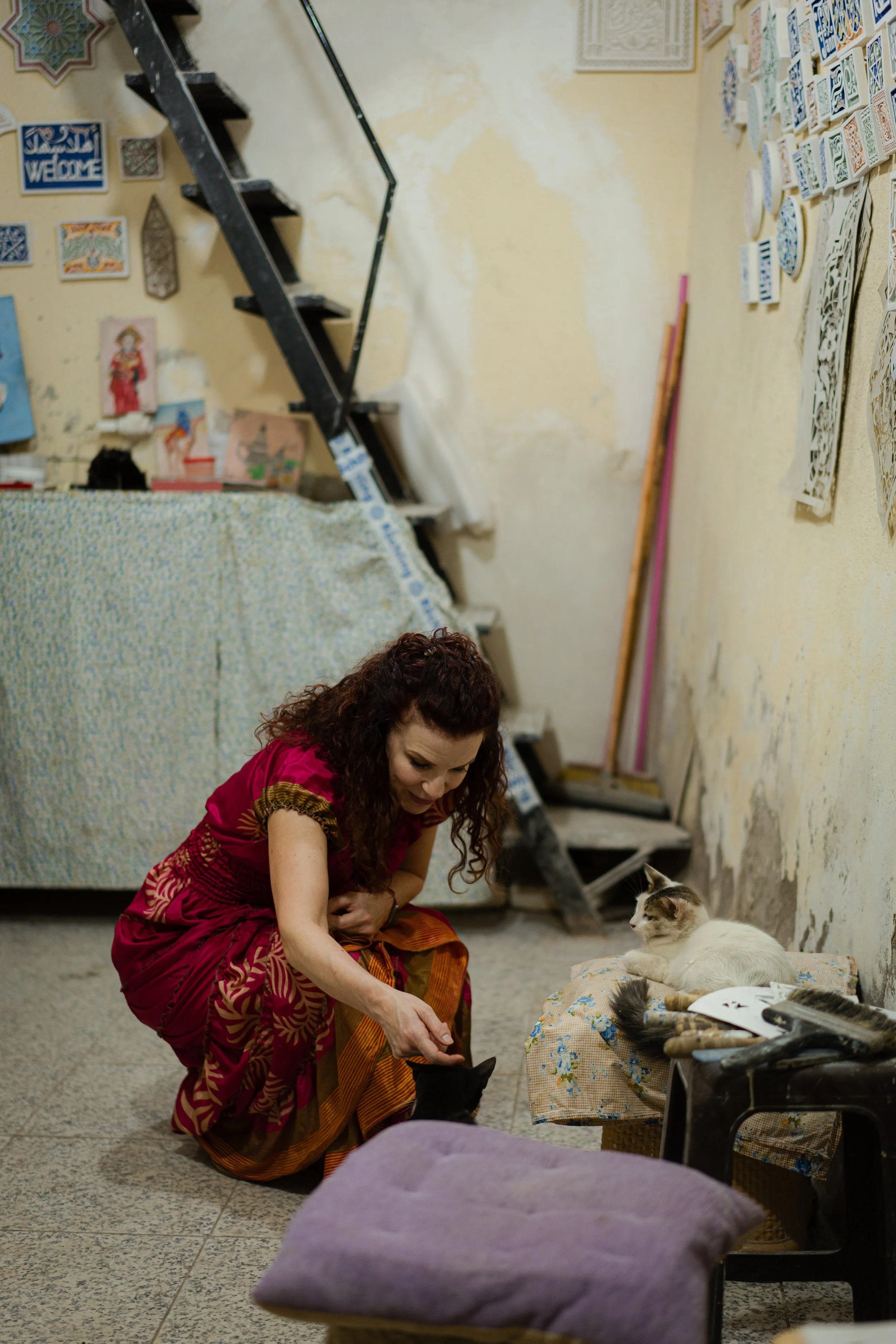
Petting the workshop “assistants” of master gebs artisan Aziz el Amin, Marrakech Medina. Photo by Omar of Marrakech Photo Shoot
In October 2023, my Morocco retreat group was set to arrive less than two weeks after a devastating earthquake. Friends and family were worried. A few people asked if we should cancel.
Canceling never crossed my mind—but changing our approach did.
The first thing I did was reach out to my friends in Morocco—people I’ve known for years through decades of performing and from traveling there—and ask the only question that mattered: How are you? How are your families? Then I listened. I stayed in close contact, sent kind words and support, kept an eye on the aid efforts, and watched as Moroccan friends here in the U.S. flew over to help. Such a kind and generous culture and people.
Before my guests arrived, I collected and purchased donation items—jackets, blankets, school supplies for children—and arranged a trusted local contact for delivery. I arrived early, as I always do, and this time my usual pre-retreat organizing also included checking safety conditions and what was open.
We went. It was meaningful. And every dirham our group spent in the medina that week went directly into an economy that needed it.
That’s what responsible travel actually looks like. Not a checklist of rules—a way of showing up. I unpack what that means beyond the carbon footprint conversation in What Responsible Travel Actually Means.
It Starts With People
I grew up in a house where our holiday tables were never just family. My father was a physics professor, and our dining room was filled with his graduate students from India, Egypt, Germany, Kenya—people from everywhere, sharing their traditions with us. That’s where I first learned that despite different customs and languages, we all want the same fundamental things: to be understood, to belong, to connect.
Later, 25 years as a professional cultural dance artist deepened that education in ways I couldn’t have predicted. Performing at weddings, nightclubs, and celebrations across Middle Eastern, North African, and Indian communities, I learned something essential: there’s a real difference between cultural appreciation and cultural appropriation. Appreciation means learning the history, respecting the context, building genuine relationships over years—not just borrowing what looks beautiful on Instagram. (Narrator voice: Samira started performing long before Instagram, however!)
When I lead retreats, this is the foundation. My guests don’t observe a culture from behind a bus window. They sit with artisans, cook alongside local chefs, and learn traditions from the people who’ve been practicing them for generations.
Responsible Travel Tips You Can Use Anywhere
You don’t need to lead retreats to travel responsibly. Here are some things I’ve learned over 20+ years that anyone can put into practice.
Support Living Artisans, Not Just Vintage Shops
We all love a beautiful vintage find—I do too. But here’s something worth remembering: when you buy from a modern artisan, you’re supporting a person who is creating right now. You’re helping keep a tradition alive, not just collecting a relic of one. Morocco has incredible art training centers—silver jewelry and wood inlay artisans in Essaouira, zellige tile and painted wood (zwaq) masters in Marrakech, the Azlag dagger collective in the Valley of the Roses. On my upcoming Hands of Marrakech retreat, my guests will actually learn these crafts from the artisans themselves, in their real workshops.
Do Your Homework on “Women’s Cooperatives”
In Morocco, you’ll find cooperatives for rugs, rose oil, and argan products everywhere. Some are genuinely empowering women. Some are essentially gift shops with good marketing and maybe even mass produced items from China. I check around, ask questions, and make sure the organizations I bring my groups to truly support the women working there. I understand enough Arabic to overhear the real conversations—the kind where an owner asks about a specific weaver’s life circumstances to see if she has an urgent need for a sale. That level of care for individual artisans is what you’re looking for.
Protect the Ecosystems You’re Visiting
This one’s practical. In Roatán, Honduras, where we hold our Joyful Shift retreat, the coral reef is extraordinary—and fragile. We use reef-friendly sunscreen (sunscreens free of oxybenzone and octinoxate) and I encourage guests to swim in long sleeves and lightweight pants instead when possible. It’s a small shift that makes a genuine difference. Bring refillable water bottles everywhere you go. Pay attention to climate education opportunities at your destination—in both Kenya and Roatán, farm-to-table meals and local conservation efforts are part of the experience.
Give Directly to Organizations Doing Real Work
On my Kenya safari retreats, we always visit the Sheldrick Wildlife Trust—the world’s most successful elephant orphan rescue and rehabilitation program. Watching those baby elephants stumble around during feeding time is pure joy, but what matters more is the work behind it: anti-poaching teams, veterinary units, habitat preservation, and community outreach across Kenya. We donate during every visit. When you travel, look for organizations like this—ones with transparent missions, deep local roots, and measurable results—and contribute directly.
Choose Small and Local Over Big and Generic
Eat where locals eat. Stay at locally owned riads and lodges. Hire local guides. Take cooking classes run by local families—on my Morocco retreats, we cook at a farm and chef school that specializes in training women to become professional chefs. Your money goes further when it stays in the community, and the experiences are richer because of it. I break down exactly where that money ends up in The People Behind Your Trip. Companies like the UK-based Responsible Travel have been championing this approach since 2001: travel that does good simply creates better experiences.
It’s Not About Being Perfect
Responsible travel isn’t about guilt, and it’s not about getting everything right. It’s about showing up with curiosity, respect, and the willingness to learn. It’s understanding that you’re a guest in someone’s home, their culture, their ecosystem—and that being a good guest makes the whole experience better for everyone, including you.
I’ve been leading retreats for a decade now, but my “choose local and support nature” travel style has been strong over three decades, and I still learn something new every trip. That’s the point. Stay curious. Ask questions. Spend your money where it matters. And if you want to see what responsible, culturally immersive travel actually feels like, I’d love to show you.
Check out my upcoming retreats in Morocco, Kenya, and the Bay Islands—or just click Contact and tell me what’s on your travel wishlist. I love hearing from you.
With sunshine and stretches,
Samira
P.S. I’ll be talking about responsible travel at some upcoming bookstore events—details coming soon. If this topic lights you up as much as it does me, those conversations are some of my favorites. You can join my email list below to find out about all my events and for more tips.