The People Behind Your Trip: Where Your Money Actually Goes
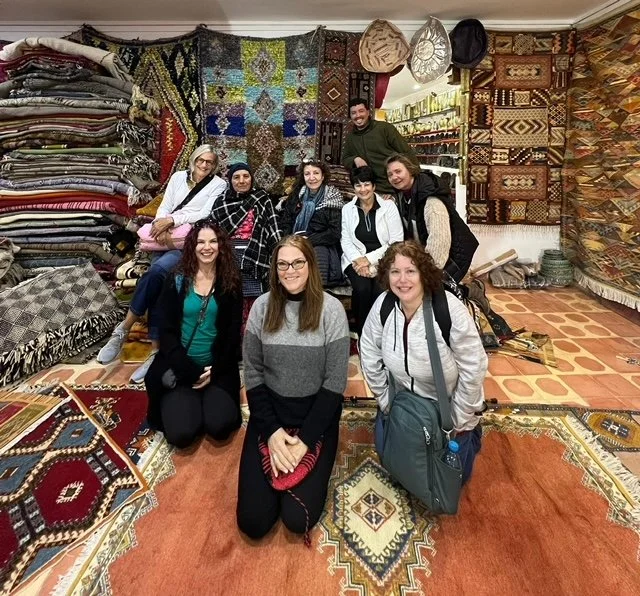
Shopping in Morocco is not what you think it is. You don’t walk in, browse a rack, and tap your credit card at a register. No, no, no. Shopping in Morocco is an education and a sales pitch rolled into one — a fascinating, sometimes funny, sometimes frustrating experience that my guests and I just call “the show.” The rug show. The medicine show. The silver show. It’s always entertaining.
And if you pay attention, it’s also how you learn who to spend your money with to have the most positive impact on the local community.
Four Rug Shops in Imlil
In 2019, while staying in the beautiful mountain town of Imlil in the Atlas Mountains, I visited four different rug shops. I wanted to learn — how to determine quality, the different types of weaving, the symbols and their meanings. But I also wanted to figure out who I felt good buying from.
One shop had beautiful rugs but the owner was really pushy, which I find uncomfortable in a negotiating situation. Another was pushy and his rugs weren’t great quality either. But two shops stood out — both had gorgeous variety, beautiful quality, and owners who were genuinely helpful teachers. They wanted me to understand what I was looking at, not just buy something quickly. I found out later they’re brothers.
Both shops are women’s cooperatives — meaning the rugs are handwoven by local women who receive about 90% of every sale. I chose to shop at Said’s shop. And that’s where I’ve been bringing my guests ever since.
“You’re My First Sale Since Covid”
My May 2020 Morocco retreat was postponed. Then postponed again when Morocco shut down before our 2021 dates. That retreat didn’t happen until 2022.
When we finally visited Said in Imlil, he had the same cell phone from 2019 — cracked screen and all. We talked a little about how the shutdown had been for the village. Morocco relies heavily on tourism, and Imlil is a trekking hub. But Said told me something that stayed with me: people didn’t go hungry in his village because people take care of each other. “No one in Morocco goes hungry,” he said.
My guests loved his carpets. And when the first guest was ready to pay, Said reached under his counter for the charge card machine. It was buried on a shelf, clearly untouched for a long time. He paused, looked at it, and said with a quiet laugh: “I forget how to use it. You’re my first sale since Covid.”
First sale since Covid. And it was 2022.
Every single one of my guests made at least one purchase that day. Some bought two or more full-size rugs. And somehow this good news made it back to Said’s family, because his mother came down to meet us while we were still shopping. She was a doll — and I could see where he gets his sweetness from.
What “Supporting Local Communities” Actually Looks Like
Everyone in travel marketing talks about “supporting local communities.” It’s become a checkbox. But what does it actually mean when it’s real?
It means my guests go home with beautiful handwoven rugs they’ll treasure for decades. Said and his family are taken care of. And the women who made those rugs — women who live in and around Imlil — receive about 90% of the sale. Not a percentage skimmed through layers of middlemen. Ninety percent going directly to the maker.
Win-win-win. That’s not a marketing phrase. That’s what it actually is.
Here’s the other side of that coin. There are shops in Morocco now—more of them in the big city medinas—selling lower quality, factory-made items from China or elsewhere. Purchasing from them still supports a shop owner, and tourism dollars are still coming in. But much of that money is supporting unfair labor practices in a completely different country, and none of it is preserving the artisan traditions that have been part of Moroccan culture for centuries.
I never make my guests feel guilty about those choices. If it brings someone joy to buy a “Come to Morocco!” t-shirt, that’s still tourism dollars at work. But when we can also support the cultural arts and do more sustainable good for the culture and community, it feels more enriching for everyone.
The relationship doesn’t end when the trip does, either. When the earthquake hit Morocco in September 2023, Said and his brother were among the first people I checked on. We visited and shopped with him again in 2023. And again in 2025. He has a new phone now.
Why Cooperatives Matter
Women’s cooperatives in Morocco aren’t a tourism gimmick. They’re economic structures that give women income, independence, and community—things they’ve built for themselves, on their own terms.
When you buy a rug from a cooperative, your money doesn’t disappear into a corporate supply chain. About 90% of it goes to the woman who spent weeks at her loom. It goes to her family. It stays in her village. And it validates a model of business that centers the maker, not the marketer.
As a traveler, the most powerful thing you can do is choose where your money goes. Not just whether to spend it, but with whom. My money at Said’s shop — it supports a family who supports their local community, artisans who carry on incredible cultural arts, and a cooperative model that empowers the women in that community.
It’s About Relationships, Not Transactions
This is what I mean when I talk about traveling with care. It’s not about finding the cheapest deal in the souk or even the “most ethical” option on some checklist. It’s about being curious enough to visit several shops before choosing one. Not everyone can come back year after year. But, we can all find these lovely shop owners on social media and check in with them, especially if hardship has befallen their area.
What Said offers is the generosity of sharing his knowledge, his culture, and his family’s craft. What we offer in return is curiosity and interest, fair purchases, and genuine care. That’s the exchange we aim for in all my retreats. Mutual respect, mutual benefit. Everyone walks away richer. For more concrete ways to put this into practice on your own trips, I’ve laid them out in Responsible Travel Tips That Actually Matter.
Warmly,
Samira
P.S. If you’ve ever bought something while traveling that still makes you smile when you see it — I’d love to hear that story. Those are the souvenirs that matter.