Mat Pilates vs. Reformer Pilates: What Joseph Pilates Actually Intended (And What Your Body Needs Now)
During World War I, a German-born fitness trainer named Joseph Pilates found himself interned in a camp on the Isle of Man. His fellow internees were bedridden, deconditioned, and losing hope. He didn’t have a studio full of gleaming equipment. He had hospital beds.
So he took the beds apart.
He rigged springs from the bed frames and created resistance systems so his bedridden patients could exercise lying down. That improvised contraption eventually evolved into the Reformer and other Pilates apparatus we know today. But here’s what most people don’t realize: the mat work came first. Joseph Pilates developed a complete system of exercises that required nothing but your own body and a floor—and he considered it the full expression of his method.
The apparatus was originally designed to help people who couldn’t yet do the mat work on their own. Over the decades, of course, apparatus work has evolved far beyond that original purpose—today’s Reformer, Cadillac, and Wunda Chair exercises can be tremendously challenging and varied. But I think the origin story still matters, because it tells us something important: mat Pilates was never the “simplified” version. It was the foundation.
What does Pilates do for your brain?
Here’s something that gets lost in the “mat vs. apparatus” conversation: Pilates was never just about the physical exercises. Joseph Pilates called his method “Contrology”—the complete coordination of body, mind, and spirit. The mental engagement is the practice. Breath is the thread that ties all of it together, and I break down exactly how in The Breath Pilates Actually Teaches.
Both mat and apparatus work engage your brain—that’s part of what makes Pilates, Pilates. But they do it differently. On the apparatus, the springs and carriage give your body feedback and guide your movement patterns. Your brain is working, but it has a partner. On the mat, your brain is the partner. You have to recruit the right muscles, maintain your alignment, and control the tempo entirely through your own awareness.
That’s not a knock on apparatus work—it’s just a different kind of mind-body challenge. And it’s why the skills you build on the mat translate so directly to real life. Nobody’s spotting your alignment when you’re picking up groceries, chasing grandkids, hiking a trail in Kenya, or navigating the cobblestones in a Moroccan medina. Your brain has to do that work. Mat Pilates trains it to.
My training lineage reinforces this. I studied under Dr. Jean Sabatine, who learned from Jerome Robbins—the legendary Broadway choreographer who practiced Pilates directly with Joseph and Clara Pilates in New York City. That’s just two instructors between me and the source. And what came through that lineage wasn’t just a set of exercises. It was a philosophy: movement is inseparable from awareness. Mind, body, spirit.
What does mat Pilates with weights involve?
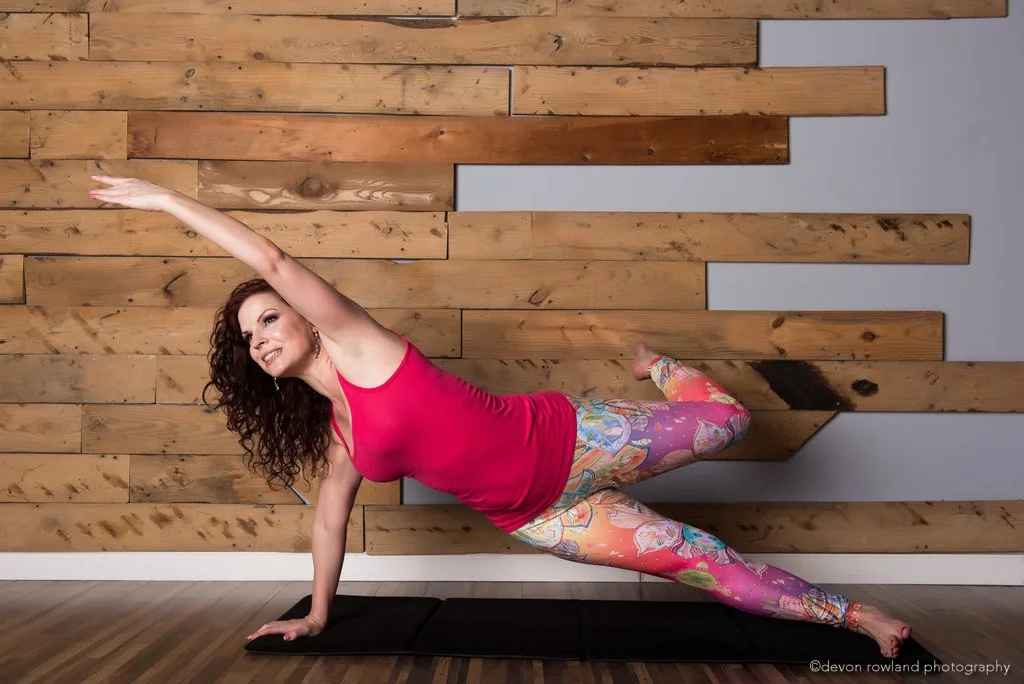
In my classes at the Yoga Center of Columbia, my Level 1–2, Level 2, and Level 2–3 mat classes all incorporate resistance props—hand weights, resistance bands, Pilates rings, fitness balls. This isn’t about making mat work fancier. It’s about creating resistance challenges that simulate what apparatus provides while adding something else: enormous variety.
A Reformer is a wonderful tool, and the range of apparatus out there—Reformers, Towers, Chairs—offers plenty of variation. But props on the mat give us the freedom to move in directions and combinations that complement and expand on what any single piece of equipment can do. We can address the body from every angle, which matters a lot when you’re living a modern life of desk sitting, phone scrolling, and car commuting.
Why do modern bodies need a different starting point?
As a certified Sports Conditioning Coach, I bring something specific to my mat classes: injury prevention. I think of it as “pre-hab”—the work you do before something goes wrong, compared to the rehab you do with a physical therapist after it already has. This training gives me a lens for spotting where Pilates exercises and physical therapy exercises overlap—and how to adapt both for a body living a modern American lifestyle.
Here’s a good example. Classical Pilates includes a lot of lumbar forward flexion—exercises where the lower spine rounds forward. For Joseph Pilates’s original students, that made sense. But so many of us now spend eight or more hours a day sitting with our lower backs in a slight forward curve. We’re already in chronic lumbar flexion. Adding more of it before we’ve developed the deep muscle strength to support the spine can make things worse, not better.
That’s why my Level 1 classes have less lumbar forward flexion than a classical program. We strengthen and heal first. We build that deep core support—the muscles that stabilize you from the inside—so when students progress to more demanding movements, their bodies are ready. This is the same distinction I teach in Imprinting vs. Neutral Spine. I learned this partly from my own back injury, when my orthopedic surgeon indicated surgery was inevitable and I became my own case study, adapting everything I knew about Pilates to heal without going under the knife. What I discovered didn’t just save my spine—it made my teaching better for everyone.
Should you choose mat or reformer Pilates?
The Pilates you’ll actually do consistently. That’s always the right answer.
If you love the feel of a Reformer and it gets you in the door, wonderful. If the cost or scheduling of private or semi-private apparatus sessions creates a barrier, mat work with props gives you a complete, challenging, and endlessly variable practice—often at a fraction of the price. And mat Pilates builds a kind of body awareness you can carry with you everywhere, because there’s no machine doing part of the work. It’s just you, your brain, and whatever surface you’re standing on.
What I’d love for you to take away from this: don’t underestimate the mat. It was the original. It’s the foundation. And in the right hands with the right props, it’s anything but basic.
P.S. If you’re curious about what mat Pilates with weights actually feels like, come try one of my classes at the Yoga Center of Columbia. First-timers are always welcome—and you might surprise yourself. Here’s my Pilates class schedule, and here is the New Student Special - 3 weeks of unlimited classes for $59!
With sunshine and stretches,
Samira