The Muscle You Didn’t Know You Needed: Why Gluteus Medius Changes Everything
If I asked you to name the muscles in your glutes, most people would say “the glutes” and leave it at that. Maybe “glute max” if they’ve been around fitness for a while. But your glute max has a smaller, lesser-known neighbor — your gluteus medius — and it plays a critical role in how you move, balance, and stabilize through almost everything you do in a day.
It’s also left out of a lot of studio fitness classes, typical Pilates classes, and yoga. And that’s a problem, because when your glute med isn’t doing its job, the list of things that start compensating is long.
What does the gluteus medius do?
Your gluteus medius is your primary side-to-side stabilizer. Every time you take a step, stand on one leg, shift your weight, or change direction, your glute med is a key part of the system that keeps your pelvis level and your body from collapsing to one side.
When it’s weak or not firing properly, your body has to compensate. And compensate it does — all the way up and all the way down the chain. SI joint pain. Piriformis issues. Balance problems. Knee pain, especially that nagging inner-knee ache that seems to come from nowhere. Even ankle instability. One underperforming muscle, and the ripple effect is enormous.
Think about what you do every single day. You walk. You go up and down stairs. You step off curbs. You shift your weight to reach for something on a high shelf. Every one of those movements requires your glute med to stabilize your pelvis. And if you’re someone who hikes, travels, kayaks, or treks through uneven terrain — the demands go up significantly.
This is why I spend time on it in every class. The bodybuilding and bikini bodybuilding communities have been way ahead of the curve on this — there are entire glute channels on social media, Bret Conteras is a researcher with a PhD in glute science whose work has informed my own teaching alongside physical therapist workshops. But in typical studio classes and yoga? Glute med work is still surprisingly rare.
Why do most classes skip the gluteus medius?
Classical Pilates was brilliant for its time — and much of it remains brilliant today. But the original repertoire didn’t include targeted glute med work the way we understand it now. Neither does most yoga. The exercises I teach for this muscle aren’t classical Pilates. They’re informed by Pilates principles — precision, control, awareness — but they draw on what we’ve learned from sports science, physical therapy research, and yes, the bodybuilding community about hip stabilization and functional movement.
I mention this in class sometimes, not to diminish the classical work, but because I think it’s important to understand that good teaching evolves. Joseph Pilates was an innovator. I think he’d be the first person to say: if we know more now, use it.
How do you strengthen the gluteus medius?
We come at glute med from multiple angles — literally. Different positions challenge the muscle differently, and variety helps you build both strength and the awareness of when this muscle is actually firing.
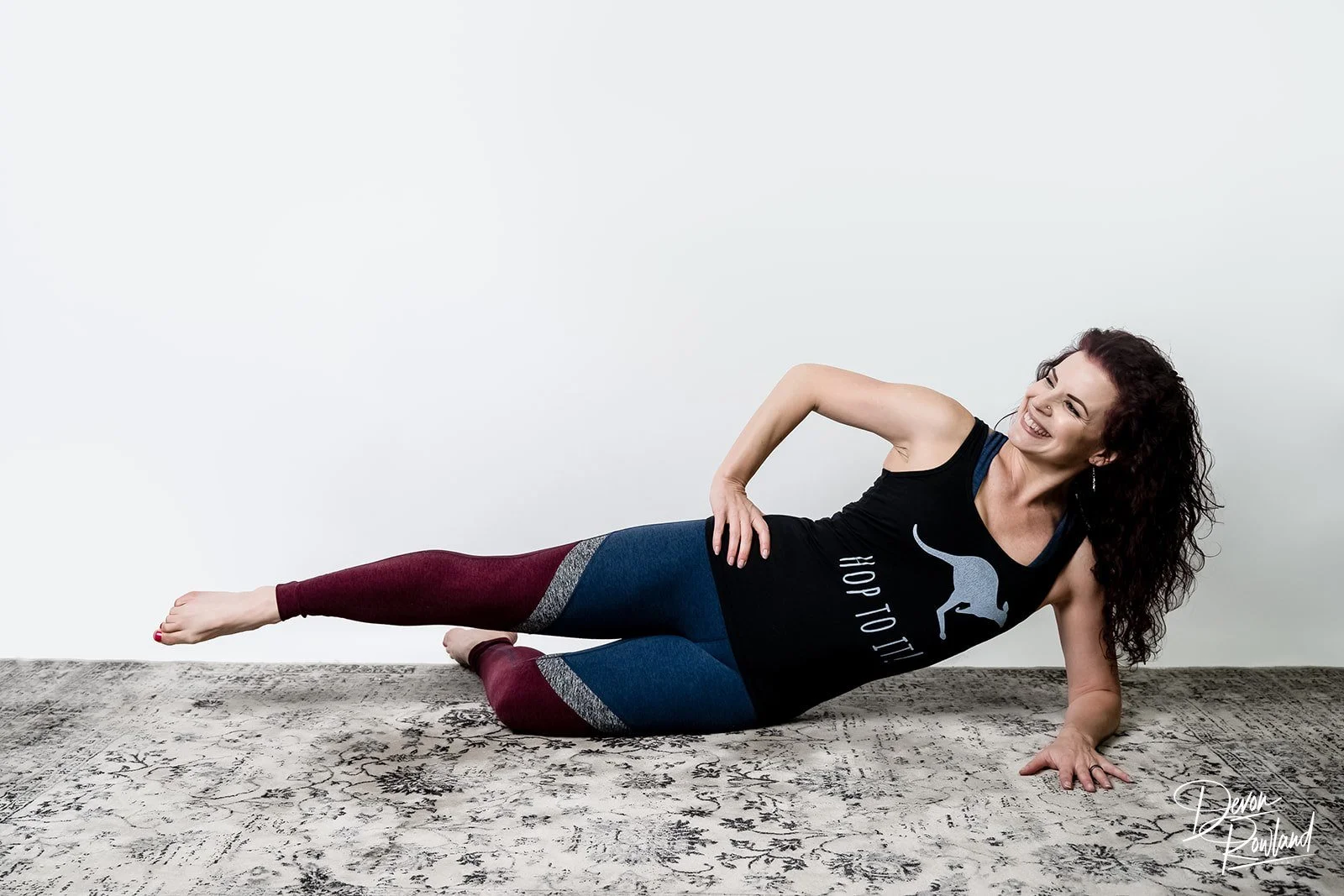
Side-lying leg work is where many people first feel their glute med working. Lifts, circles, controlled movements with the leg in slight internal rotation — these isolate the muscle in a way that’s hard to cheat. Add ankle weights or a resistance band, and the demand goes up quickly. Side-lying double hip abductions and their variations target the muscle through external rotation at the hip, and they’re deceptively challenging when done with proper form. These are all examples of open chain movement, where you move distal segments of the body (hand, foot, etc.) to create isolation of a muscle.
Shoulder bridges are another tool — but not the way you might expect. We use a wide stance with external rotation initiated from the hips (your feet stay in regular position, just comfortably apart) and a strong posterior pelvic tilt. This combination shifts the emphasis from glute max and hamstrings toward glute med in a way that most standard bridges don’t. They are also important in the repertoire as a closed chain component, meaning the distal segment (hand, foot, etc) is on a stable surface and you move multiple joints creating functional movement.
But one of my favorites for this muscle is standing 45-degree hip extensions in external rotation, with or without a band. It is an open chain movement. Here’s why I love them: they’re not just an effective strengthening exercise, they’re also one of the best ways to help people actually isolate and feel this muscle activating. When your glute med turns on during a standing hip extension, you know it. There’s no guessing, no wondering if you’re using the right muscle. You feel it in exactly the right place. That moment of connection — oh, THAT’S what she’s been talking about — is one of my favorite things to watch happen in class.
What difference does a strong gluteus medius make?
Strong glute med muscles don’t just fix problems — they prevent them. This is the “pre-hab” work I’m always talking about: building the strength and stability now so that injuries don’t happen later.
For my students who travel and do adventure activities, glute med strength is what keeps your knees happy on a long descent, keeps you stable on uneven ground, and gives you the balance to navigate a rocky trail without thinking about it. One of my students told me he wouldn’t have been able to do gorilla trekking through the jungle without the work we do in class. That’s not just core strength — that’s hip stability, and glute med is a huge part of it. It’s exactly the strength I build into the walking days on my Kenya retreat, where the savanna terrain doesn’t forgive a weak hip. If you want more on building this kind of travel-ready strength, I wrote about it in Your Body Is Your Best Travel Companion.
For daily life, it’s simpler but just as meaningful. It’s stepping off a curb without your knee wobbling. It’s carrying groceries up the stairs without your hip aching. It’s standing on one leg to put your pants on in the morning and realizing you don’t need to hold onto something anymore.
Where glute med fits in the bigger picture
This is why I love teaching the way I teach — connecting the specific, sometimes unglamorous exercise to the real reason it matters in your life. Glute med work might not look impressive, but the impact on your back, hips, knees, balance, and overall function is hard to overstate.
If you’ve been dealing with any of the issues I mentioned — SI joint pain, piriformis tightness, balance problems, knee aches — there’s a good chance your glute med is part of the puzzle. Come try a class and find out.
Warmly,
Samira