Culture Isn’t a Photo Op: What Genuine Connection Actually Looks Like
There’s a tradition in Arab nightclubs that holds both strength and softness, that is absolutely beautiful. During the mawwal — the improvised vocal section before a song really kicks in — the singer calls out all the different Arab countries represented in the audience. People often cheered loudest when their own country is called, but cheered for every one.
What happens next is the part that always moved me: when a country was going through particular hardship — usually due to conflict — everyone would cheer louder. Not just polite applause. Extended whistles, zaghareets and applause. Real solidarity. Real love. For a moment, the whole room says: we see you, we’re with you. People’s hearts are held with both strength and softness.
I saw this tradition every Saturday night for over a dozen years at Alf Leyla Wa Leyla, a Palestinian and Yemeni-owned nightclub where I performed. The band was Moroccan and Iraqi musicians with a Lebanese singer named Roni. My family is from Australia, and one night, Roni added a shout-out for Australia in amongst all the Arab countries. Everyone cheered. It was both funny and incredibly sweet — a small, generous gesture that said: you’re part of this, too.
That tradition taught me something I’ve carried into every retreat I lead: genuine cultural connection isn’t something you observe. It’s something you’re invited into.
You Can’t Stage This
There’s a version of cultural tourism where everything is curated for the visitor. A “traditional” performance, a quick photo, a souvenir. Everyone smiles, nobody truly connects, and the culture becomes something consumed rather than shared.
The moments I’m talking about are different. They can’t be scheduled or scripted. They happen when you create the right conditions — small groups, genuine respect, enough time to let people relax into being themselves — and then you get out of the way.
On our most recent Morocco retreat, something happened that I couldn’t have planned if I tried. Our driver, Hassan, was quiet and shy the entire trip. Sweet, professional, always taking care of us. We’d learned a few things about him over the days together — that he likes Adele, that he’s married with two children — but he was truly a private person.
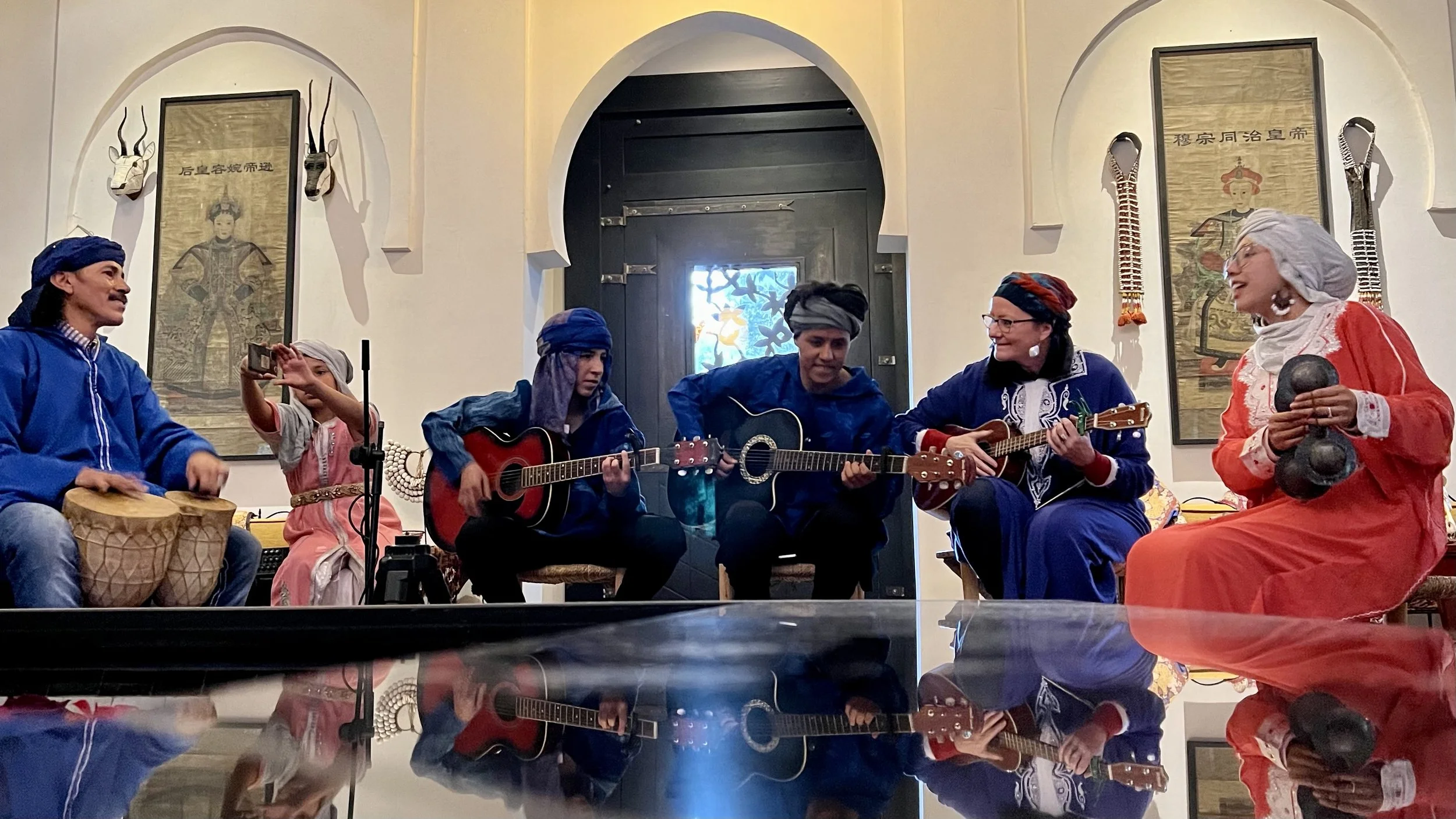
On our last night in the Valley of the Roses, I’d hired local musicians for a party. And Hassan lit up the dance floor — both with his smile and his dancing. His joy absolutely filled the room. We learned that when he was about three years old, his mother pulled him up to dance with her, and he’s loved dancing ever since.
His joy made everyone want to dance. And then a woman who worked at the kasbah — who is deaf — joined in. She loved to dance, and her encouragement got every single one of my guests up and moving. The joy of community took over. The movement, the music, the connection — it was felt by everyone in the room, regardless of language or hearing or how well anyone danced.
That’s what genuine cultural engagement looks like. Not a performance staged for tourists. A room full of people sharing something real.
What Makes Moments Like This Possible
I’ve thought a lot about why these moments happen on my retreats and not on most tours. It comes down to a few things. Some of the same thinking runs through What Responsible Travel Actually Means — it’s less about carbon offsets than about how you actually show up.
First, small groups. Twelve to sixteen people. That’s it. You can’t have a genuine exchange with forty strangers on a bus. But with twelve people, the local musicians can look you in the eye. The driver can relax and be himself. The artisan can actually teach you, not just demonstrate while you file past.
Second, time. We don’t rush. When I hire musicians for an evening, it’s not a thirty-minute show. It’s a party. There’s room for the shy driver to warm up, for a conversation to develop, for people to move from watching to participating at their own pace.
Third — and this is the one most travel companies miss — the people we’re visiting aren’t performing for us. They’re sharing with us. There’s a difference, and everyone in the room feels it. Hassan wasn’t dancing for the tourists. He was dancing because his mother taught him to love dancing when he was three, and the music moved him. We were lucky enough to be there. That’s part of why I care so much about where a trip’s money actually goes — I wrote about it in The People Behind Your Trip.
The Honor of Being Invited In
The deepest cultural experiences I’ve had haven’t been the ones I planned. They’ve been the ones I was invited into.
I know very clearly that I am a guest in these cultures. I always have been. The connections I’m describing weren’t earned by being special. They were earned by showing up consistently, listening more than talking, and understanding that being welcomed into someone’s tradition is a gift, not an achievement.
Being invited to break fast with families during Ramadan. That’s an honor. You don’t earn that with a booking fee. You earn it through years of genuine relationship, showing up with respect, and understanding that you’re a guest in someone’s most sacred traditions.
At Alf Leyla Wa Leyla, I wasn’t included in Roni’s country call because I paid for a table. I was included because I’d been part of that community for years — performing, learning, showing up Saturday after Saturday, learning Debke, knowing the words and meanings behind the songs, getting to know multiple generations, building real relationships with real people.
This is what I try to create the conditions for on my retreats. I can’t guarantee you’ll have a moment like Hassan on the dance floor. But I can guarantee you’ll be in a space where that kind of moment is possible — because the relationships are real, the groups are small, and the respect goes both ways.
Warmly,
Samira
P.S. Joy is contagious. Enthusiasm is mesmerizing. I’ve seen it on dance floors from Philadelphia to the Atlas Mountains, and it never gets old.